
A Crystal Made of Time: Physicists Build the First All-Optical Photonic Time Crystal

Category
Innovation
Explore more in this category
An international team has made light itself behave like a lattice — not in space, but in time. Here is what a photonic time crystal is, how gold, indium antimonide and a terahertz accelerator made it real, and why it could rewrite optical computing and lasers.
For sixty years, the standard way to control light has been to build something in its path: a lens, a fibre, a mirror stack, a nanostructured crystal. Every one of those tricks works in space. Put the right pattern of material in front of a photon and you decide where it goes.
A team from École Polytechnique, Collège de France and the Helmholtz-Zentrum Dresden-Rossendorf (HZDR) has just demonstrated the other axis. Writing in *Nature*, they report the first all-optical photonic time crystal (PTC) — a material whose optical properties repeat not across millimetres of space, but across picoseconds of time. Light does not pass through a lattice. Light passes through a rhythm.
The idea in one paragraph
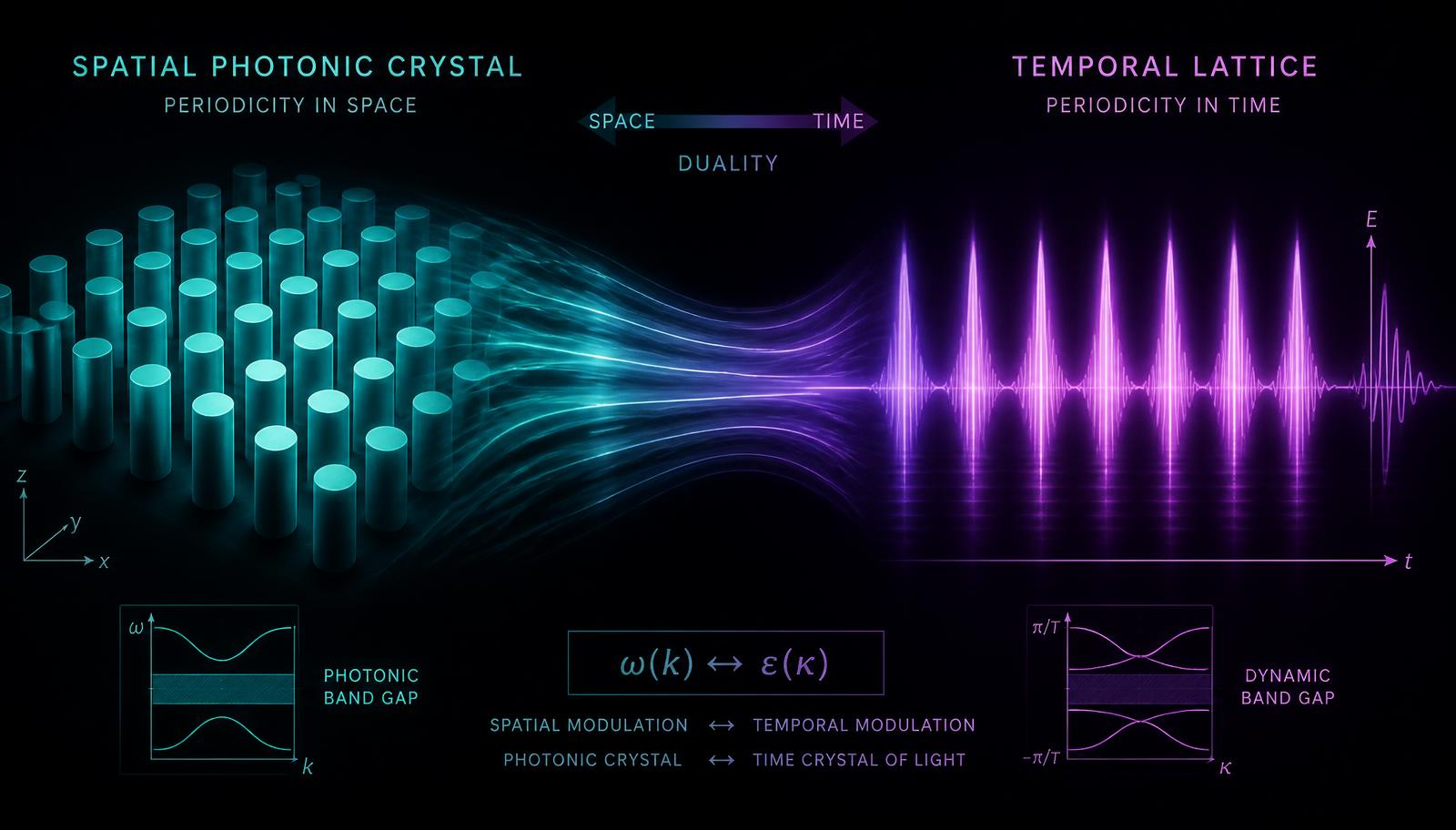
A conventional photonic crystal is a repeating optical pattern — alternating refractive indices arranged like a checkerboard or a stack. That periodicity creates a *photonic band gap*: certain wavelengths simply cannot propagate, the same way a semiconductor's band structure decides which electrons move. Everything a photonic crystal does — guiding, filtering, trapping, slow light — comes from that spatial repetition.
A photonic time crystal keeps the physics and swaps the axis. Instead of the refractive index changing as you move through the material, it changes as time advances, and it does so periodically. The result is a band structure in *frequency* rather than in momentum, with what physicists call momentum gaps. Inside those gaps, light is not blocked. It is amplified — the modulation itself pumps energy into the wave.
That amplification is why the idea has been chased for a decade. It is also why nobody had built one at optical or near-optical frequencies until now.
Why it took so long
Two requirements have to be satisfied at the same time, and they fight each other.
1. The modulation has to be fast. To count as a time crystal, the material's optical properties must change on a timescale comparable to the light's own oscillation period. At terahertz frequencies that means picoseconds — roughly a trillionth of a second per cycle. 2. The modulation has to be strong. A one-percent wobble in refractive index does nothing useful. You need the material's response to swing dramatically, the optical equivalent of an object changing colour outright.
Electro-optic modulators are strong but slow. Ultrafast pump-probe tricks are fast but weak. Nearly every previous attempt landed on one horn of the dilemma. The new work clears both because of a deliberate choice: work in the terahertz band, where light oscillates fast enough to be interesting but slow enough that a picosecond kick can keep up with a full cycle.
The device: gold crenellations over a semiconductor
The sample is a *plasmonic metamaterial*, fabricated with help from Thales' Laboratoire Albert Fert and Polytechnique's PICM lab.
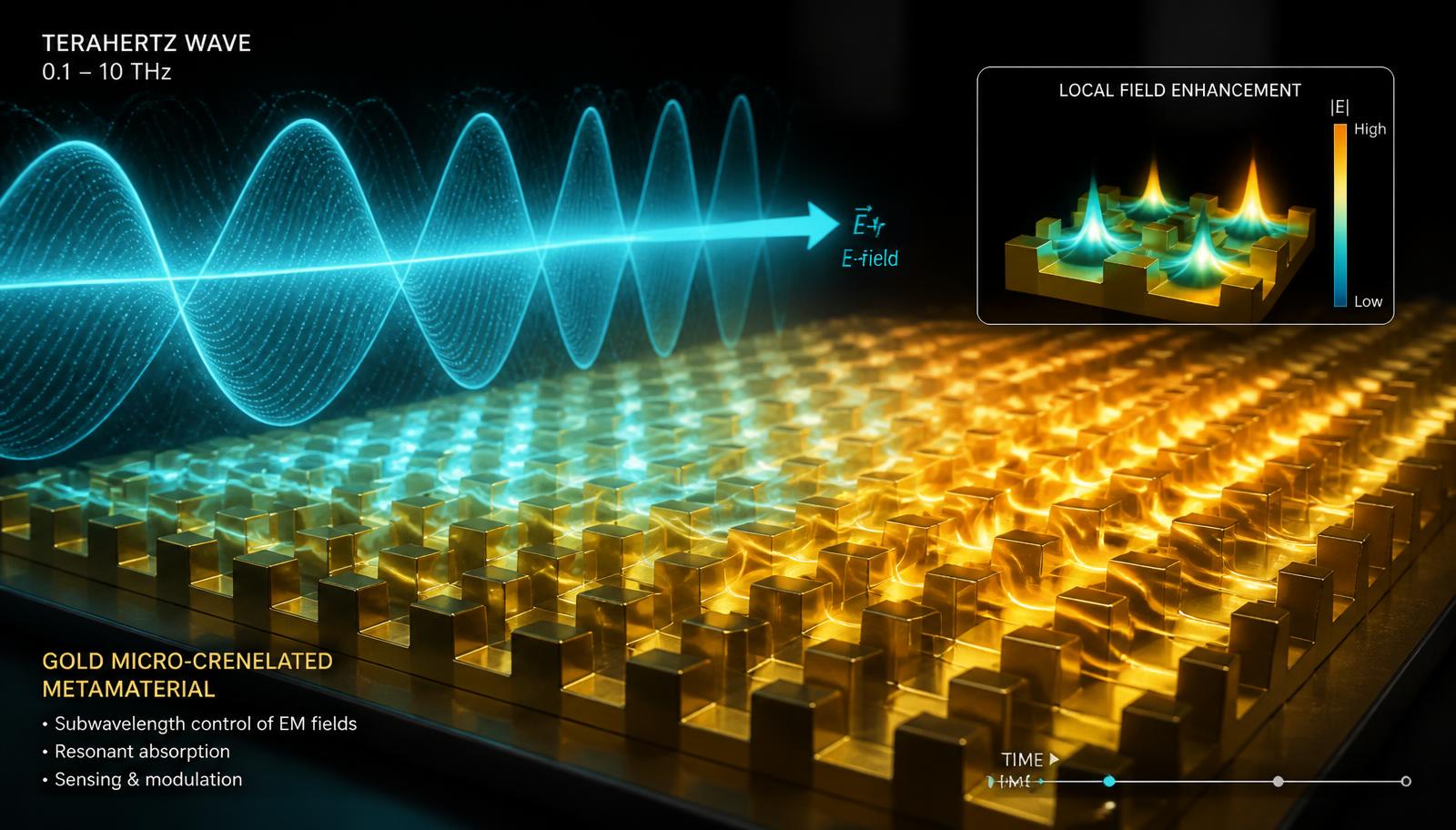
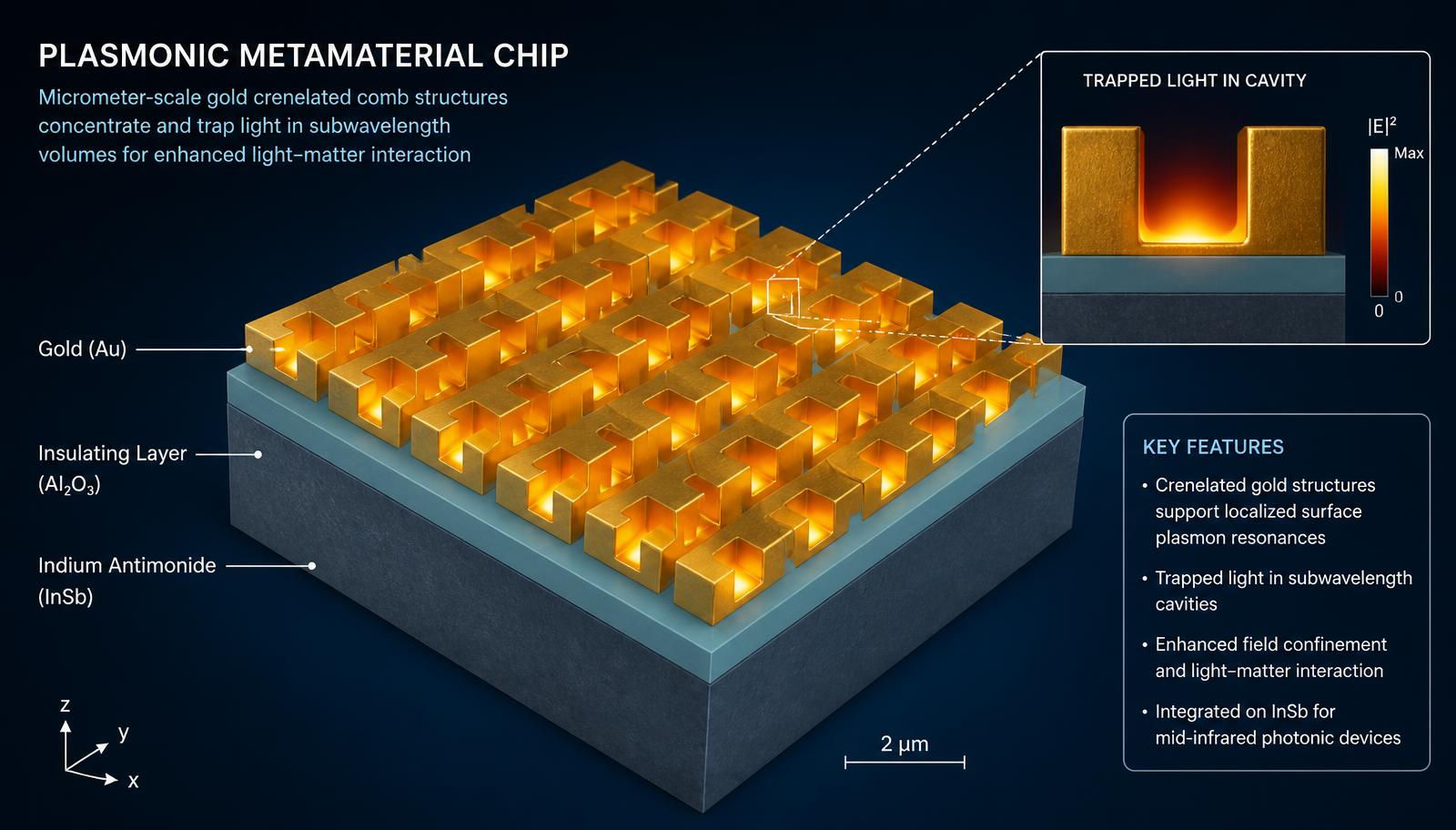
- Top layer: micrometre-scale gold structures, shaped like the crenellations on a castle wall. Each notch behaves as a tiny resonant cavity.
- Middle layer: a thin insulator that separates the metal from the active material.
- Bottom layer: a semiconductor alloy of indium and antimony (InSb) — chosen because its carrier density, and therefore its dielectric response, can be pushed hard and recover fast.
When the semiconductor surface is driven, it hosts surface plasmons: collective oscillations of its electron sea. Those plasmons hybridise with the light trapped in the gold cavities, holding photons at the interface instead of letting them escape. That confinement is the lever. Because the light is pinned in a subwavelength volume against a material whose electronic state can be shaken in picoseconds, a modest change in the semiconductor becomes a violent change in what the light sees.
The machine: TELBE
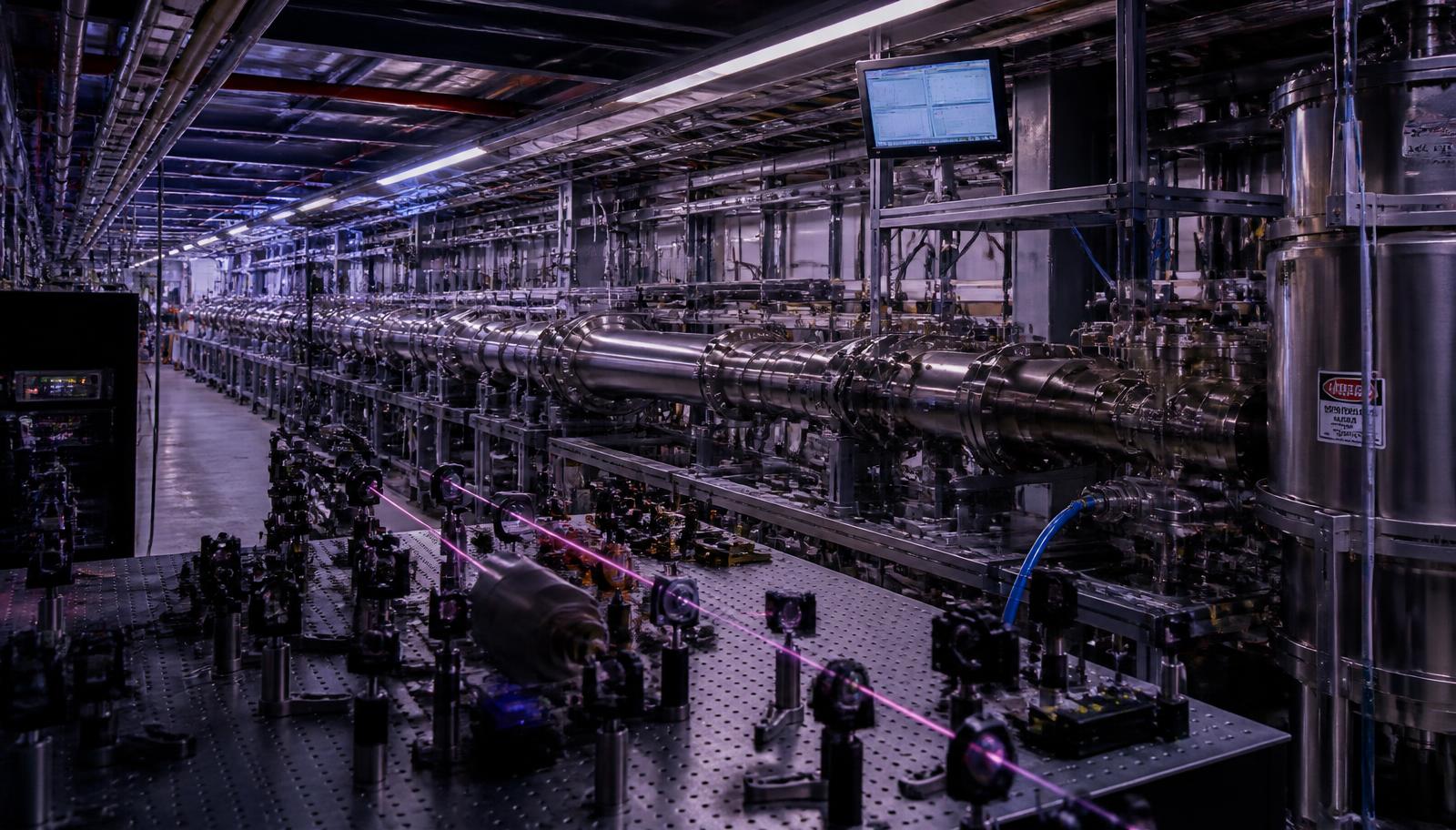
The drive pulses came from TELBE, the superradiant terahertz source at HZDR's ELBE accelerator — one of very few facilities in the world that can deliver terahertz pulses that are simultaneously high-field, tunable in frequency, and *phase-stable* shot to shot.
Phase stability is the unglamorous requirement that made the experiment possible. A time crystal is defined by the timing of its modulation relative to the light's own phase. If the drive's phase jitters between pulses, the temporal lattice smears out and the effect averages to nothing. TELBE's coherence let the team lock the modulation to the wave.
As facility coordinator Jan-Christoph Deinert put it, without that infrastructure the coherent, ultrafast modulation needed for the PTC regime would simply not have been reachable.
What they measured
Under terahertz illumination, the metamaterial's reflectivity and resonance frequency shifted strongly and repeatedly on picosecond timescales — the periodic-in-time modulation that defines the regime. Crucially, both boxes were ticked at once: the swing was large, and it happened within roughly one optical cycle.
A theoretical model from Marco Schiró's group at Collège de France reproduced the measurements and explained the photon dynamics inside the structure. It also surfaced the result the team finds most promising: modulating the material in time cut photon dissipation roughly in half. Dissipation here means the fraction of photons that leak through the metamaterial's surface instead of being reflected. Halving it means the temporal lattice is not just reshaping light — it is helping keep it.
Why halving the losses matters more than it sounds
Amplification in a photonic time crystal is a race. Every modulation cycle pumps a little energy into the trapped field; every cycle also loses photons to absorption and leakage. Net gain arrives only when pumping outruns loss. That threshold is exactly where a device stops being an interesting modulator and becomes a laser — one whose gain comes from the timing of the material rather than from a population inversion in a gain medium.
The team is not there yet. They are, for the first time, measurably on the right side of the ledger, with a clear engineering path: reduce dissipation further, and increase the number of photons the crystal can hold.
What this could eventually enable
Terahertz sits in the awkward gap between electronics and photonics — roughly a thousand times faster than the switching speeds of conventional electronic components, yet far less developed than either neighbour. Closing that gap is the practical prize.
- Ultrafast optical computing. Switching and routing light on picosecond timescales, without converting to electrons and back.
- Adaptive communications. Hardware whose filtering and frequency response can be retuned in flight rather than fixed at fabrication.
- New terahertz lasers. Time-modulated gain, tunable in colour and intensity on demand — useful for medical imaging, spectroscopy and security screening, where terahertz penetrates materials that visible light cannot.
- Advanced imaging and sensing. Terahertz is non-ionising and sensitive to molecular vibrations; brighter, tunable sources widen what can be seen with it.
The honest caveats
This is a laboratory result on a specialised sample, driven by an accelerator-based light source that exists in a handful of places worldwide. It is not a chip. Lasing has not been demonstrated, only the loss reduction that points toward it. Scaling the concept to shorter wavelengths — the near-infrared and visible bands where telecoms and computing actually live — remains genuinely hard, because the modulation speed requirement scales with the light's frequency.
None of which diminishes what changed. For a decade, photonic time crystals lived in theory papers and simulations. As lead author and PhD student Tingwen Guo frames it, extending photonic crystals from space into time opens a new dimension for controlling light — and a new route to amplification. The dimension is now experimentally occupied.
References and further reading
- ScienceDaily: World-first photonic time crystal opens a new era of light control
- Nature: journal homepage for the original research publication
- Helmholtz-Zentrum Dresden-Rossendorf: the TELBE superradiant terahertz facility
- Laboratoire des Solides Irradiés (LSI), École Polytechnique
- Collège de France: Marco Schiró, theory of driven quantum matter
- Nature Photonics review: photonic time crystals and temporal metamaterials